RPLL - Manila - Ninoy Aquino International Airport - Friday Fly-In
General
The Ninoy Aquino International Airport has 2 Runways, 4 passenger terminals, 2 general aviation areas, 1 military airbase, 1 maintenance hangar, and 1 presidential ramp.
- Terminal 1 - International and Cargo Terminal
- Terminal 2 - Domestic Flights
- Terminal 3 - International and Domestic Flights
- Terminal 4/5 - Currently under construction
The airport caters passenger and cargo flights, as well as general and military aviation.
NOTAMS
| Date | Description |
|---|---|
| Active May 18 2026, 1:37 PM CEST Ends Aug 18 2026, 1:59 AM CEST | TWY F1B CLOSED DUE WORK IN PROGRESS (CONST OF TWY FM COORD 143124N 1210011E TO 143046N 1210050E). RPLLYNYX B2158/26 |
| Active Aug 13 2026, 2:50 PM CEST Ends Oct 26 2026, 9:00 PM CEST | MON THU SAT 1400-2000 TWY J AND P CLOSED DUE WORK IN PROGRESS (CONST OF TWY). RPLLYNYX B4115/26 |
Charts
Frequency List
| Designator | Callsign | Frequency | Remarks |
|---|---|---|---|
| RPLL_ATIS | 126.400 | Every hour | |
| RPLL_DEL | Clearance Delivery | 125.100 | DCL [RPLL] |
| RPLL_P_GND | Manila Planner | 122.000 | Event's only |
| RPLL_1_RMP | Apron Control One | 121.700 | Terminal 1 |
| RPLL_2_RMP | Apron Control Two | 128.800 | Terminal 2 |
| RPLL_3_RMP | Apron Control Three | 121.350 | Terminal 3 |
| RPLL_G_RMP | Apron Control GenAv | 123.250 | GenAv |
| RPLL_GND | Manila Ground | 121.800 | |
| RPLL_TWR | Manila Tower | 118.100 | |
| RPLL_F_APP | Manila Finals/Departure | 124.400 | 1500ft - FL150 |
| RPLL_S_APP | Manila Approach | 127.700 | 8000ft - FL150 |
| RPLL_N_APP | 119.900 | ||
| RPLL_APP | 124.800 |
Stand Assignments
Bay assignments, are strictly implemented virtually, and are based on the latest real-world operations. Virtual and other real-world airlines that are not listed will park at terminal 1.
Runways
Manila currently only has 2 runways that intersect each other.
Hours of Operation
| Days | RWY 13/31 | RWY 06/24 |
|---|---|---|
| MON, WED, FRI | H24 | 0000Z – 2200Z, 2220Z – 2359Z |
| TUE, SUN | H24 | 0000Z – 1630Z, 2130Z – 2359Z |
| THU, SAT | 0000Z – 1500Z, 2000Z – 2359Z | 0000Z – 2200Z, 2220Z – 2359Z |
Below is a table of the Take-Off Run available
Take-off Run Available.
| Runway | Intersection | TORA ft (m) |
|---|---|---|
| 06 | E4 | 6,854 (2089) |
| E5 | 10,098 (3078) | |
| 24 | E1 | 9,951 (3033) |
| E2 | 7,733 (2357) | |
| 13 | F1 | 6,148 (1874) |
| F2 | 4,701 (1433) | |
| 31 | F4 | 4,948 (1508) |
| F5 | 6,516 (1986) |
Warning
Runway 31 is only for departures.
Routes
Local flights within RPHI and some international flights are to use routes given below. Simbrief also give a standard route which looks like this

If your route is still invalid, a controller will send you a private message with your new route. Routes within RPHI are to follow the half-moon principle in both RVSM and non-RVSM conditions. During events you will have 5 minutes between the time you request clearance and the time you request pushback, or you will have to wait until a new slot is available.
Warning
During events it is important that you put your EOBT in your flight plan as controllers will use that to determine your takeoff slot.
Waypoint Restrictions
Waypoint Restrictions
| FIR | Waypoint | Airway | Altitude (FL) |
|---|---|---|---|
| HONG KONG | NOMAN / SABNO | A583 / A461 / M501 | 300 / 340 / 380 |
| SINGAPORE | TEGID | M767 | 310 / 320 / 350 / 360 / 390 / 400 |
| LAXOR | L649 | 300 / 380 | |
| M772 | 300 / 380 | ||
| N884 | 320 / 360 / 400 | ||
| HO CHI MINH | PANDI / ARESI | M765 / L628 | 280 / 340 |
| N500 | 300 | ||
| MIGUG | N892 | 310 / 320 / 350 / 360 / 390 / 400 |
Clearance
On first contact with the controller that will issue your clearance, it is recommended for you to give the following information:
- Your bay number
- Your aircraft type
- The ATIS information letter
Phraseology
PAL300: Clearance Delivery, PAL300, stand 10, A-3-2-1, with Information Alpha, request clearance Hong Kong, runway 06
Warning
Radio Checks on first contact are discouraged when building communication with the controller. It's best to greet or ask the controller, should you need any help before clearance issuance.
Be straightforward and concise as possible when communicating within a controlled frequency.
Once you have requested for clearance, the controller will either tell you to standby, or give your clearance on the spot. Clearances include your routing, flight level restrictions, departure instructions and your squawk.
You must read back the clearance in full. Listen carefully to all details that the controller gives you, and if you are unsure about your clearance, let the controller know.
Phraseology
CEB585: Clearance Delivery, CEB585, Stand 120, A-3-2-0 with information A, request clearance Mactan, runway 06.
RPLL_DEL: CEB585, cleared Mactan, W25 BATAY, RUNWAY 06 IPATA2R, Climb 7000, Squawk 4251
CEB585: Clearance Delivery, CEB585, Stand 120, A-3-2-0 with information A, request clearance Mactan, runway 06.
RPLL_DEL: CEB585, cleared Mactan, W25 BATAY, RUNWAY 06, fly runway heading, climb 7000ft, expect radar vectors IPATA, squawk 4251
Pushback
Normally, a controller will instruct you to push back to the nearest start-up point. The location of the start-up points are indicated in available charts
Warning
- Do not preplan your pushback!
- Connect the tug first!
Phraseology
CEB585: Apron Control Three, CEB585, Stand 120, request push, runway 06.
RPLL_3_RMP: CEB585, push approved, S14, face G12
A controller may push you to a certain reference point due traffic
Phraseology
CEB585: Apron Control Three, CEB585, Stand 120, request push, runway 06.
RPLL_3_RMP: CEB585, push approved, abeam gate 119, face G12
Departure
The departure procedure is decided by an online Approach (APP) or En-route Controller (CTR). When both are offline, Standard Instrument Departures (SIDs) are given by the aerodrome controllers (TWR, GND or DEL). When either APP or CTR is online, they decide if departures will be given radar vectors (climb and heading instructions) to the TMA exit points or will be following a SID.
When APP or CTR is online, after passing 2000 feet or 5 DME from RPLL, report your passing altitude to APP or CTR. This is to help them identify you successfully in their radar screens.
Phraseology
PAL300: “Manila Departure, PAL300, on runway heading, passing 2000 climbing 7000”
RPLL_F_APP: “PAL300, radar identified, continue climb 7000”
Runway 31
For all departing IFR traffic on runway 31 must use the HARBO1 Departure.
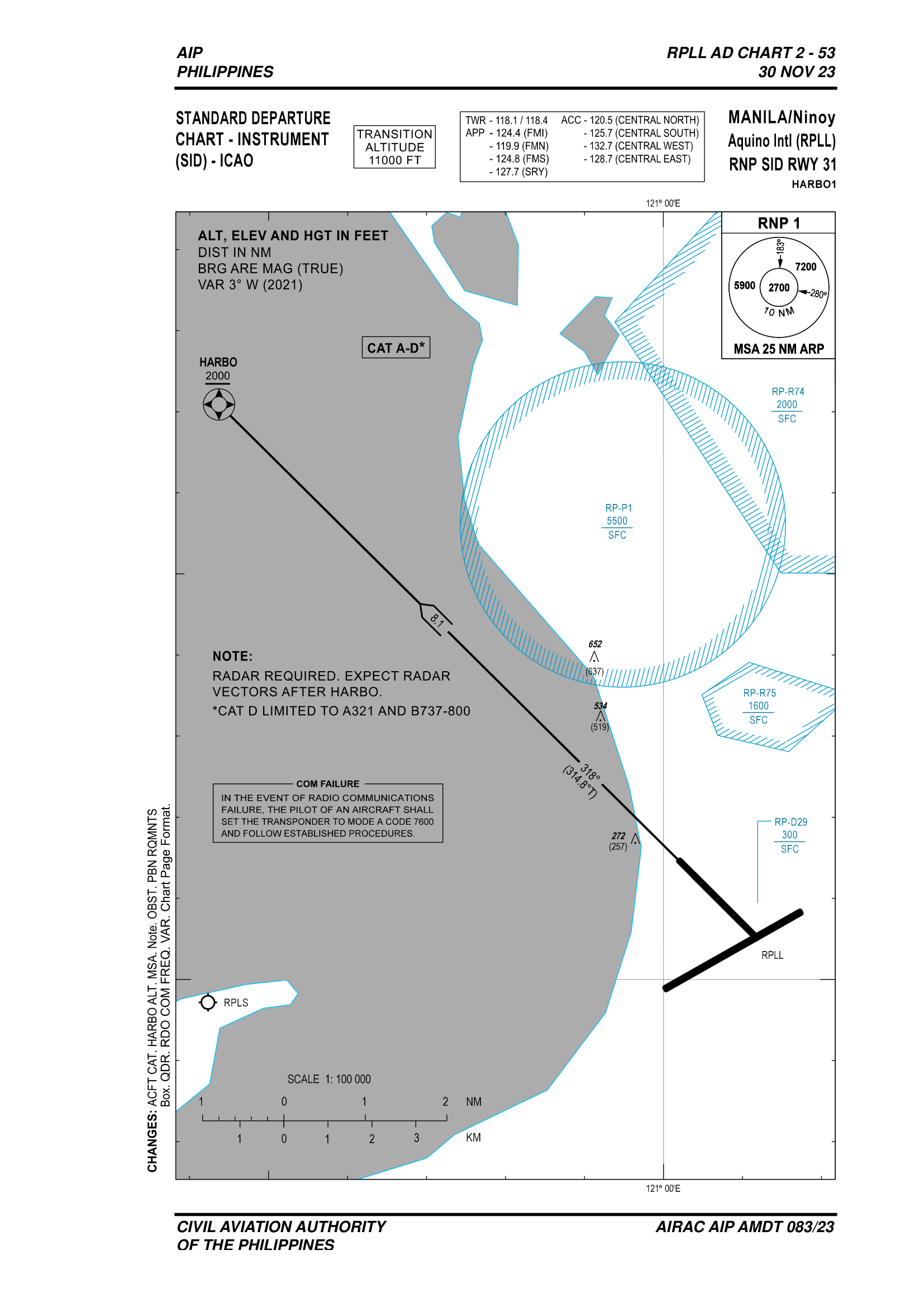
After HARBO, Maintain 318°(M) until instructed by ATC.
Runway Occupancy Time-Departure (ROTD)
At RPLL we implement ROTD - Runway Occupancy Time-Departure for A320 and lower. ROTD of 45 seconds will start at the time the aircraft reaches no 1 position (lined-up on the runway threshold marker) and the pilot reads back the ATC’s take-off clearance to the time it is airborne (wheels off the ground).
Arrival
When arriving in to Manila, it is best for you to be in between FL160 and FL200 when reaching the border of the TMA or the start of the STAR. On initial contact with Manila Approach (RPLL_APP), report your current level.
Phraseology
PAL301: “Manila Approach, PAL301, FL180, inbound TADEL”
APP will then issue your arrival clearance including the type of approach to expect to the active runway. APP will either give you radar vectors for the ILS or via a STAR. By default, controllers will issue you a STAR followed by radar vectors for the ILS.
Phraseology
RPLL_APP: “PAL301, radar contact, cleared Manila expect radar vectors ILS 06”
PAL301: “Cleared Manila expect radar vectors ILS 06, PAL301”
RPLL_APP: “PAL301, maintain present heading, descend 10,000, QNH 1011”
PAL301: “maintain present heading, descend 10,000, QNH 1011, PAL301”
Warning
If APP did not give you any turns after you have passed the last waypoint on your routing, maintain your present heading.
Below is the mandatory speed restrictions when under vectors by approach.
Please follow the following table unless instructed by ATC.
| Category | Distance (NM) | Speed (IAS) |
|---|---|---|
| All | Crossing STAR Waypoint | 250 |
| All | 20 | 210 |
| All | 10 FINAL | 180 |
| C & D | FAF/FAP | 150 |
| ATR | 5 | 150 |
| A & B | 5 | 130 |
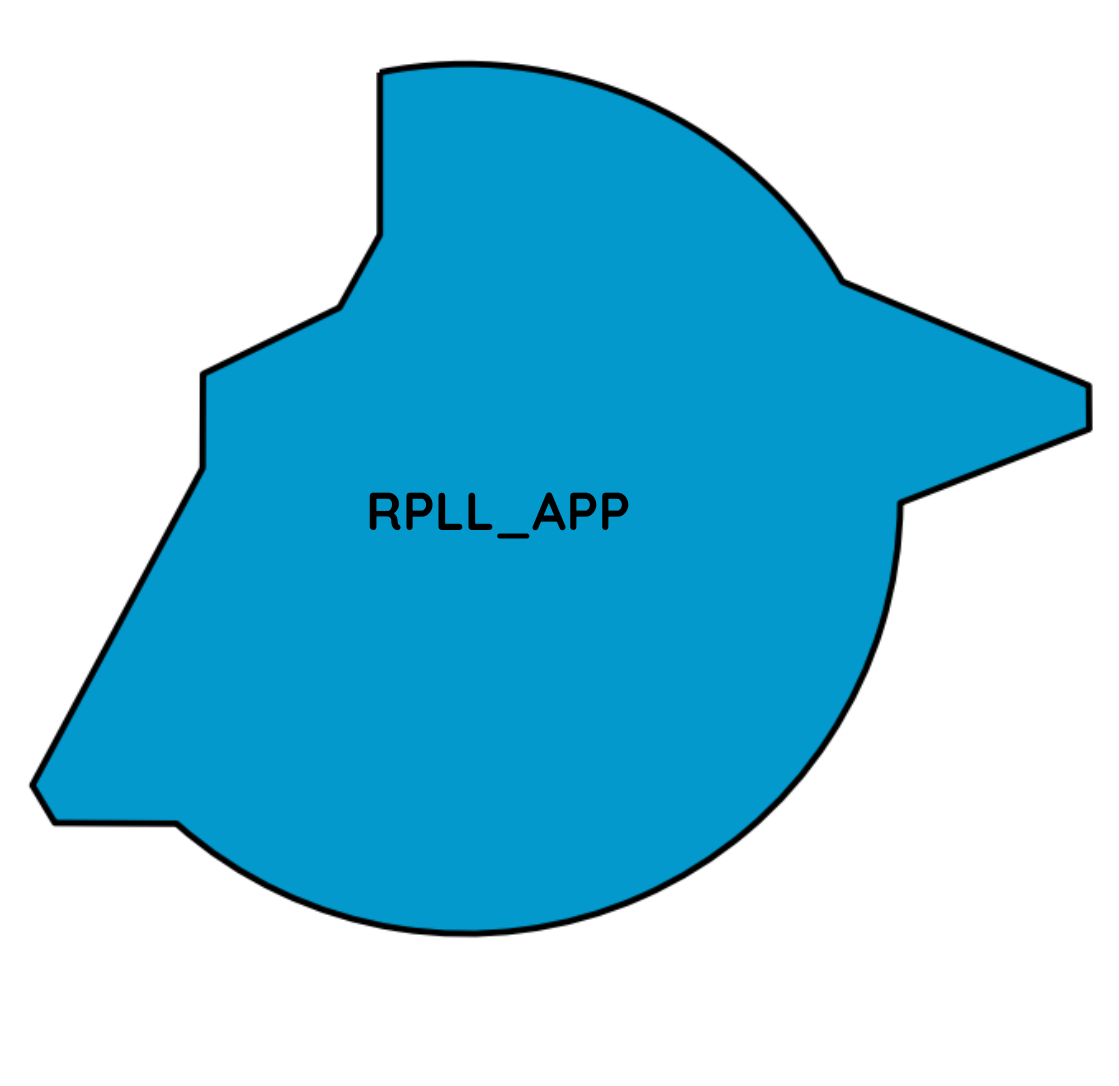
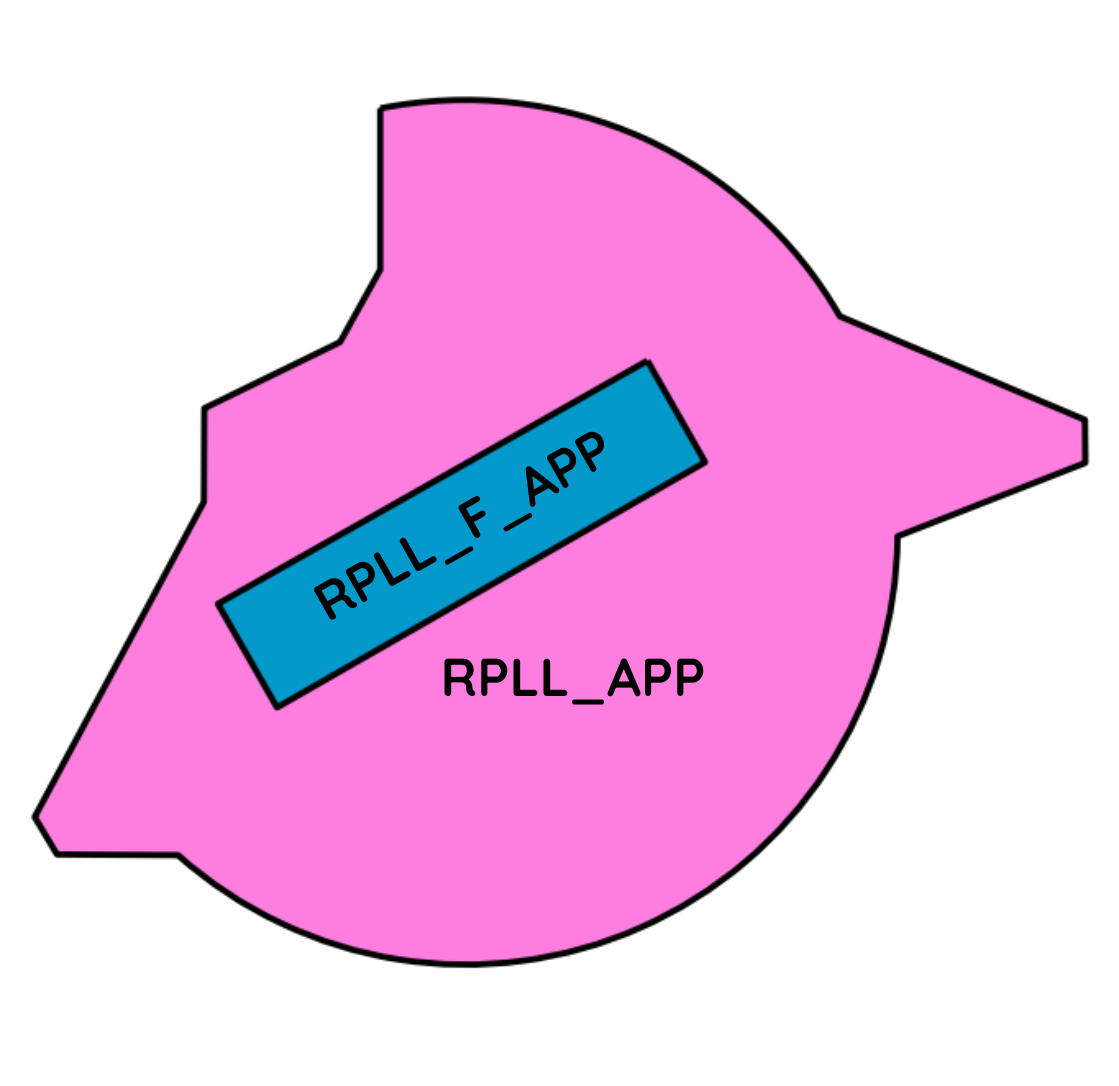
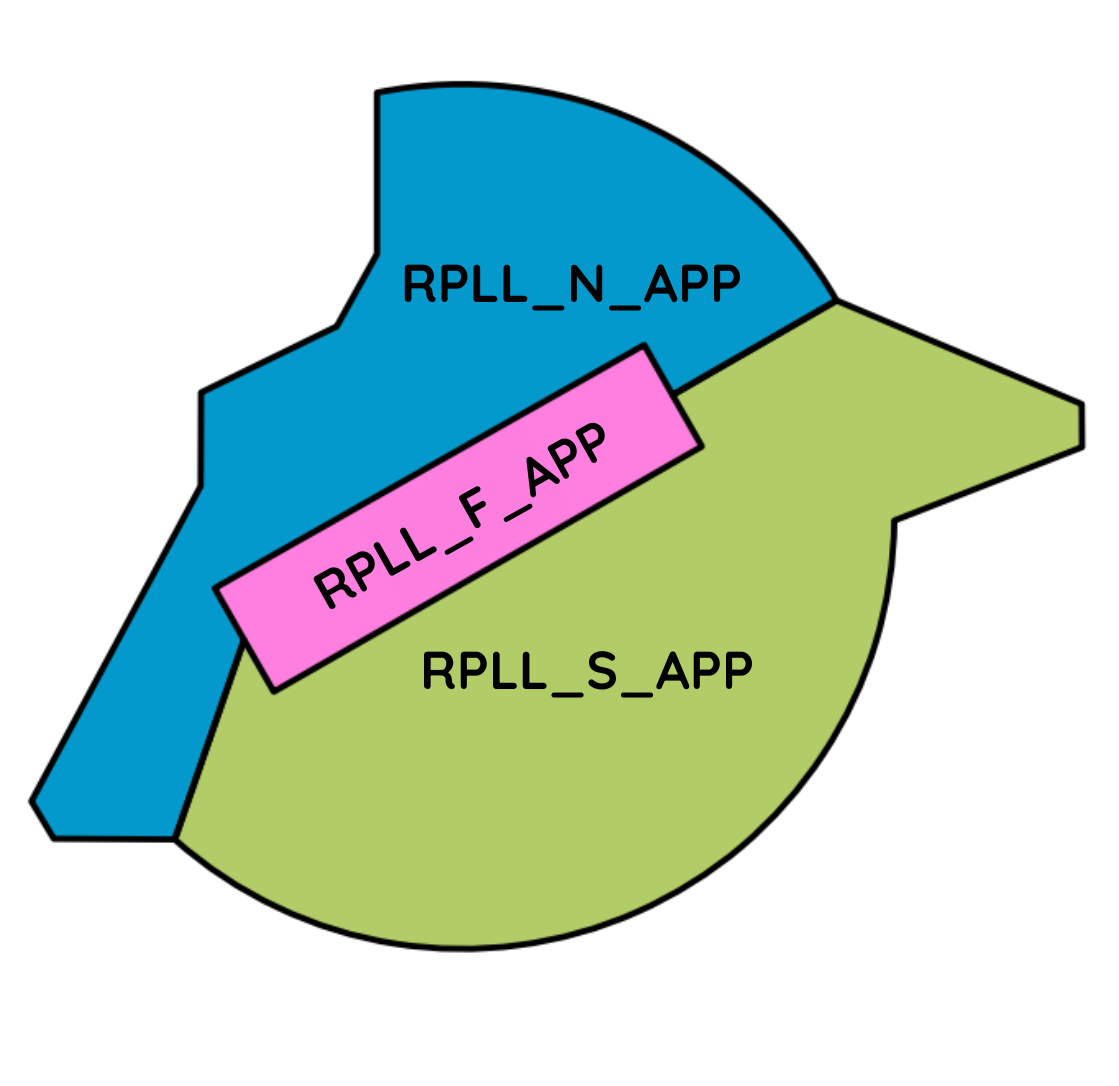
Manila Approach
Scope configurations
Vacating
You must vacate the runway as fast as possible in order for TWR to make best use of the runway.
You have not vacated the runway until you have fully passed the runway stop bar, so DO NOT STOP UNTIL YOU ARE FULLY ON A TAXIWAY or you might cause a go around.
| Runway | Category | Exit |
|---|---|---|
| 06 | A, B, C and Lower | R2, R3, E4 |
| D and Higher | E2 / R1 / E1 / H1 | |
| 24 | A, B, C and Lower | R4, E4 |
| D and Higher | R5 / E5 / H2 | |
| 13 | A, B, C and Lower | Any Taxiway on the Left/Right |
| D Limited to A321 or similar | Any Taxiway on the Left/Right |
The controller may give you a taxi instruction to vacate and some might not. If so, keep moving until you are vacated and hold position until GND has given you further instructions to taxi.
Runway Occupancy Time-Arrivals (ROTA)
For arrivals we implement ROTA - Runway Occupancy Time-Arrivals for A320 and lower. ROTA of 55 seconds will start at the time the aircraft reaches above the threshold marker to the time it vacates.